
01
Hidden Unicode
Finds invisible Unicode, decodes tag and variation-selector payloads, and reviews mixed-script lookalikes.
Free watermark checker
Check text for invisible Unicode or inspect supported files for signed Content Credentials. Review each finding before creating a cleaned copy where safe removal is available.
Your content stays in this browser
Choose input
Check complete
Unicode tags and variation selectors can encode readable text. Decoding reveals the content but does not prove it is a watermark or identify its source.
These visible characters resemble Latin letters inside the same token. Review them manually; the tool does not replace them.
Select at least one character type to create a cleaned copy.
Your original remains unchanged. Claude detector profile: pending.
SynthID Text reference detector
Check complete
Cryptographic C2PA verification
Supported checks
A clean result means no supported signal was found. It does not prove that content has no watermark or that it was created by a person.
Finds invisible Unicode, decodes tag and variation-selector payloads, and reviews mixed-script lookalikes.
Checks supported files for embedded C2PA credentials, including Anthropic signing chains. Cleanup remains PNG/JPEG only.
Pasted text receives a local reference-profile score, but it cannot become a Claude verdict while Anthropic's compatible detector profile remains private. Pixel marks and C2PA soft bindings remain unsupported.
Visual guide
Text findings are individual Unicode code points. Image findings live in metadata containers beside the pixels. The tool shows the layer it can inspect before you edit anything.
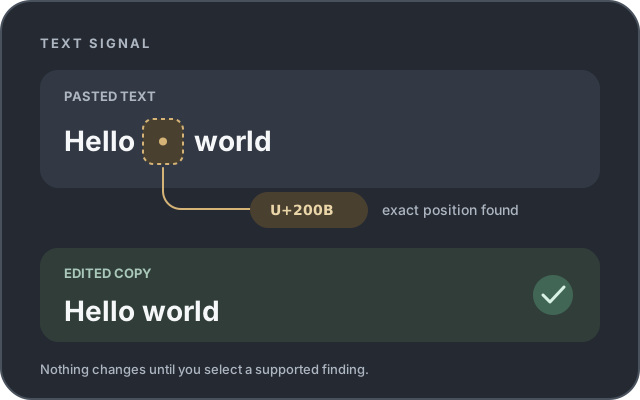
Inspect the code point, category, and position before choosing what to remove.
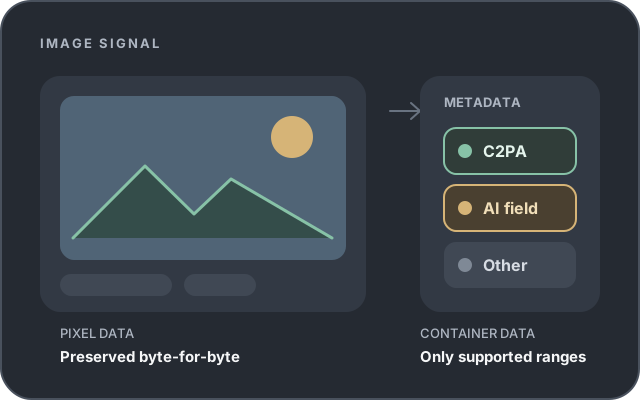
Supported metadata can be removed without repainting or recompressing the image pixels.
Statistical text watermarks
A generative watermark does not add hidden characters. It changes how an AI chooses among plausible next tokens, leaving a keyed pattern that can accumulate across a text.
One context, several plausible continuations
The harbor grew quiet as evening arrived.
Ordinary generation
Fresh randomness makes the choiceWatermarked generation
A secret key and recent tokens shape the choiceHow it works
The tool separates detection from removal. Your original text or file stays unchanged while you review supported findings and decide whether to create a cleaned copy.
Paste up to 500,000 characters or choose a supported file up to 25 MB.
See matching character types, code points, positions, metadata containers, or C2PA verification results.
Remove supported findings, re-check the result, then copy or download it.
Plain-language definition
A hidden watermark is a signal that is not meant to be obvious in normal viewing. In text, that may mean invisible Unicode characters or statistical word-selection patterns. In images, it may mean metadata such as C2PA Content Credentials or a signal embedded in pixels. These methods require different detectors; no single check covers all of them.
More from Adanos
Independent market tools and data products from the team behind WatermarkTidy.com.
Configurable real-time stock alerts, AI-powered analysis, and watchlist monitoring for investors.
Explore StockAlert.pro For developersUnified sentiment and attention data for stocks and crypto from Reddit, X, financial news, Polymarket, and crypto communities.
Explore the Adanos APIQuestions
No. Invisible characters can be legitimate in emoji, right-to-left writing systems, typography, or document formatting. A match shows which supported character exists; it does not identify who or what added it.
Watermark Tidy tokenizes pasted text locally and runs a verified DeepMind 0.2.1 reference scorer with public test keys. It reports raw statistics for an explicit GPT-2 test profile, not a provider verdict. Anthropic's official detector is in private preview and its compatible profile is not public, so Claude attribution remains unavailable.
No. It can remove supported invisible Unicode from text and supported C2PA structures from PNG or JPEG files. Anthropic describes its embedded text watermark as a separate signal. Its official detector is in private preview, but the compatible detector profile is not publicly reproducible.
It validates embedded Content Credentials in supported image, video, and audio files. PNG and JPEG also receive structural metadata inspection and are the only formats with byte-preserving metadata removal. Anthropic signing-chain identity is reported separately.
No. For supported removals, PNG image data and the JPEG compressed scan are copied byte-for-byte. The tool removes only identified metadata containers and re-checks the output before download.
No. Checks and removals run in your browser. The application has no upload endpoint, account system, analytics, or database. Loading the website itself still makes a normal request to its Cloudflare host.
No. A clean result means only that no supported signal was found. Visible overlays, pixel-level marks, C2PA soft bindings, statistical text watermarks, and unknown vendor formats remain outside this check.
Technical terms follow the C2PA Content Credentials specification and the Unicode Standard. Last reviewed September 3, 2026.